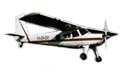
 Next Chapter
Chapter 2
The next day I flew back toward the southeast in the wake of the cold front. The sky had opened up, the visibility was excellent. When I asked Paris Information for the barometric pressure, it was several millibars higher than the day before.
The wind was the strong northwesterly which often flows after a depression crossing France. By the time I'd reached the Rhone Valley the mistral was in full swing. I climbed to 9500 feet to avoid the turbulence and crossed the lower Alps riding the standing wave, which is like an up-down elevator and just as smooth.
"Vous êtes de retour?" (You're back?) asked Nice Tower as I landed. I guessed they didn't get many U.S.-registered Helios.
"Miss me?"
The controller gave his transmitter button two quick hits, which is code for all choked emotional replies, and told me to change to 121.7.
Taxiing to Parking Lima – Lima being the pilots' alphabet for the letter L which stands for light or léger aircraft – I parked and went on foot back to the air terminal. Ever since some Palestinian commandos fired bazookas at an El Al plane at Orly Airport a while back, security at French airports had been strict. Pilots of private aircraft can no longer go out on the tarmac at Nice without special passes. I recall thinking it was strange how a conflict so far away could change everyone’s life in at least some small way. Little did I then know how strange.
Entering the terminal I saw my name written in chalk on a board set up just inside the door. The hostess at the Chamber of Commerce counter handed me a message from my passenger suggesting that if I got to Nice early enough we should leave for Greece after lunch. According to the time written on the note, he’d left it for me a half hour before. It also said that the German would be lunching in the airport dining room and suggested I join him.
I was ready to leave if he was. We were joining the game a little late and had some fast jumping to do to catch up with the other players. Nice Airport was square GO; the first toss of the dice would send us soaring out over Mediterranean Avenue, but where we'd land was anybody's guess.
Out toward Corsica and Italy I could see the cold front that had just gone through, a massive cloud buildup. The met office confirmed that it might be wiser to let the bad weather move on eastwards or we'd be overtaking it before reaching Greece. Tomorrow, he told me, the weather should be pretty good along our entire route.
Now to meet my passenger. Giving my name to the headwaiter at the elegant airport restaurant, I followed him past the immaculate tables with their white tablecloths and napkins folded like teepees to a spot by the glass wall overlooking the runway. A man of middle age, flabby, balding, got to his feet as I approached, and shook my hand.
"Mr. Tschetter?"
"That's right."
"I'm Kurt Mueller."
"Glad to meet you."
"Please, sit down. I’ve already ordered because I wasn't sure you would be joining me. Bitte."
As I sat down another waiter arrived to ask whether I wanted an apéritif. I decided to wait and see whether I’d be flying that afternoon, so he put the menu card in my hand.
"I have ordered the moules marinières to start and then the steak au poivre," Mueller told me.
Mussels and pepper steak being two of my favorites, I ordered the same.
"Wine?"
"Not just now. I’ll let you know." The worst part about flying in France is keeping sober at mealtime. French food has to be taken with wine.
As I handed back the menu card I saw the German looking excitedly out the window. "Look. A jumbo. I think he's taking off now."
A Boeing 747 – only recently introduced at the expanding Nice airport – was taxiing by, looking incredibly large from where we were sitting. As it went past I took the opportunity to study the man opposite me. Mueller looked to be in his early fifties with the pale blue eyes and weak face I associate with a nation of people who, in their pure state, have a knack for getting older and shrewder but no wiser. His hair, which had seemed blond from a distance, was mostly white.
He watched the 747 take off, excited as a kid. "Herrlich," he said, turning back to me. "Tell me, Mr. Tschetter—"
"Chet."
"Tell me, Chet, do you speak German?"
I shook my head, but it wasn’t really true. Our family being partly of German descent, my father had insisted I study German in school. Two weeks of skiing in Austria with Jeanne the year before had brought a lot of it back. Then why did I shake my head? Maybe there was something about my passenger that I didn’t completely trust. Call it professional discretion.
An enormous tureen of steaming mussels had arrived and we filled our plates, pouring on plenty of juice which smelled heavenly of onion and white wine. As the steak au poivre would probably have a red wine sauce, I figured even if I didn't touch a glass of pinard during the meal, I'd still fail a balloon test by dessert time.
"So, Chet, do you think we can leave this afternoon for Greece?"
Looking thirstily at the bottle of red on the table between us, I explained the weather situation to him, hoping he'd opt for staying overnight in Nice. No such luck. "I think we could get at least to Italy, couldn't we?" he asked.
I had to admit there was a strong likelihood that we could. From where we were sitting, the view was good and I could make out the outline of Corsica which now seemed cloud-free. Even if we couldn't get over the Apennines, we could sleep that night in Rome or Naples.
"Then I think we should leave this afternoon," said Mueller, filling my wine glass. "And I'm sure one glass won’t hurt."
His argument was persuasive. I took a sip of the wine, running it around my mouth. His argument was very persuasive. I swallowed, closing my eyes blissfully. His argument had convinced me. "Okay," I told him, consulting my watch. "Take-off time 1430 hours. If you take away that glass."
Signaling the headwaiter, the German asked him to remove my glass. The Frenchman was stunned. "Is there something wrong with the wine?" he asked in alarm. "I will have another bottle brought immediately."
"No, no. On the contrary. My friend here finds it too good," Mueller laughed. The waiter stared at us as if we were madmen. "He is a pilot," explained the German. "He is afraid of drinking too much of your wonderful wine and then he can't fly."
The Frenchman’s expression changed from horror to incredulity. "Wine is not Scotch!" But being the perfect waiter he argued no more, plucking up my glass as if glad to get its precious contents away from these stupid and unappreciative foreigners.
"He doesn't know it hurts me even more than it hurts him," I said, looking regretfully after his retreating back.
During lunch, as if by mutual consent, both Mueller and I avoided talking about the object of our trip. Terry had said that Mueller’s wife was young. If so, it was easy to jump to conclusions about why she’d run off. In a way I was just as glad Mueller was coming along to do his own dirty work, because after seeing him I wasn't sure I'd ever have been able to convince her to return without actually tying her up and bringing her back by force.
"My business, Chet," the German replied to one of my questions, "is hand tools. You know, pliers, wrenches, and so forth. In fact, I will bring some samples along with me if you don't mind. I never travel without samples. You never know who you will meet."
"No problem," I told him. "Is all your baggage here at the airport?"
"All except the samples. They are at our agency here in Nice. I will have them brought to the airport by one of my associates. Are there any formalities for taking our luggage on board?"
"Nothing in particular. We'll put your bags aboard while I'm having the plane fueled and then return to the terminal for passport control."
"And the flight plan?"
"I'll file that when we're finished eating. While I'm doing that you could call your associate to bring the samples. In fact, if you want to give him a ring now to save time, there's a phone just over there. Tell him to meet us in front of Departures in a half hour."
"Jawohl, Kapitan!"
I was glad he didn't give me a straight-arm salute before going off to telephone. His reaction reminded me that a lot of Germans are happiest and most efficient when being ordered around. Waiting for him to return, I had visions of training him to do little jobs like tying the plane down and overseeing the refueling, thus cutting our tarmac time in half.
Lunch finished, I posted Mueller in front of Departures and went to the Control Block to get the latest met and file the flight plan. Except for some muck left behind the front, some patches of stratus and so forth, Corsica was clear. It was raining in Rome and Naples, but the forecast indicated there would be clearing later in the afternoon.
To be on the safe side I filed through to Naples, naming Rome/Urbe as alternate. En route I'd get more weather information and decide where to land for the night. Back then I didn't like landing at Naples Airport where the controllers' English sounded like pure Italiano. The airport itself was a dingy affair and a sort of random labyrinth when it came to landing and departure formalities for light aircraft. Rome/Urbe was likewise sexless, but smaller and close to the center of town. This was helpful in case a general strike was going on, which was often the case.
Everything went smoothly. Mueller's man arrived on time with the case of hand-tool samples. A mechanic I knew from one of the hangars down at Parking Lima, returning from lunch, happened to notice us outside Departures and gave Mueller's luggage a lift to the plane in his car, thus saving us the trouble of carrying everything by hand through the security inspection.
The only unusual event that occurred was that while we were being gone over with metal detectors a bell went off loudly. A half dozen armed guards jumped toward one of the curtained booths out of which came my passenger looking very red-faced. The object being examined by the guards was a small monkey wrench, which had been found in Mueller’s pocket. They wanted to know why he was carrying it. To bash the first officer over the head? Or so it would feel cold, hard, and gunlike pressed into the back of the captain's neck? Or perhaps it was hollow and contained drugs. They turned it every which way and hefted it and shook it.
"It's all right," I told them. "He's my passenger. I'll vouch for him."
Eyeing me suspiciously, they handed me the wrench. It was embarrassing, and I was annoyed at Mueller, who should have known better. I had the feeling he'd done it on purpose, like a little kid trying to get attention.
"November four three eight niner, after the Caravelle on final you may line up and hold."
"Roger."
The wind had fallen considerably. When takeoff clearance came I pushed in the throttle and a moment later we were airborne in a right-hand turnout over the sparkling blue Mediterranean. Mueller, wearing a bright yellow life jacket, and with wads of cotton batting in his ears to protect him from the engine noise – I'd decided against giving him earphones – was straining to look back at the shore we were leaving. It was a great sight, the city of Nice, and the Alps with their snowy peaks.
"Herrlich," shouted Mueller over the engines roar. "Beautiful."
I always prefer passengers who appreciate the many joys of flying in light aircraft, and I liked it that Mueller was into them, too. But even so, try as I might, it didn't warm me up any to the man. Our trip had hardly begun, but I was already looking forward to the time our paths would part.
We climbed to 7500 feet in the smooth, cloudless air and a few minutes later were straight and level, heading toward Bastia. With the engine noise filling our heads, and our stomachs working away on the meal we'd just eaten, conversation was nil. It gave me a chance to think over what had happened in the past twenty-four hours.
I was on a quest to find two women, one the wife of the man sitting next to me, the other the wife of a French minister. At breakfast that morning Terry had given me a dossier on the French woman, including some photographs. She was an elegant, attractive gal of forty-two or -three with dark blond hair. The photos had obviously been taken on the grounds of the lodge with a telephoto lens and without the knowledge of the subject. It made me think what an opportunity it would be for blackmailers at a place like that. I wondered what other pictures my friend might have in her files.
It was a shoddy suspicion, but in fact the whole assignment seemed a little shoddy to me. If these two women didn't want to come home, that was their own business. The argument for them to return – that Terry Rolland would be in trouble if they didn't – was hardly likely to persuade them. On the other hand, there was always the possibility the women were being held somewhere against their wills. White slavery is still alive and functioning in the world.
Another thing intrigued me in this affair. The woman whose photographs I'd been given that morning ... there was something in her face that made me want to help her if I could. There was beauty and intelligence in her eyes, and something feminine and vulnerable. Terry said she took drugs, but it was hard to believe. The face in those photographs didn't reflect any such degradation.
Passing Elba we started catching up with the bad weather covering the Italian mainland. I filed an instrument flight plan for Naples, and a few hours later we were holding over Sorrento at 5000 feet in a gray, murky drizzle. To pass the time we listened to the control tower giving hell to another light aircraft whose pilot was having his own problems with the local accent.
Twenty minutes later, on the ground, I ran into that other pilot, whom I recognized as Drucker, a good-looking, fortyish French Jew. I'd met him a year or so earlier when he used to fly co-pilot on some millionaire's twin Beech and I recalled him telling me at the time they'd been in Tel Aviv forty-eight hours after the Six Day War. He never said why, and I didn't ask. About six months ago he'd turned up in Paris in his own French Jodel Musketeer aircraft and now here he was in Naples with a passenger, a really tarty blond, heavily made up, and about as well groomed as a sheaf of wheat.
Although Drucker shook hands with me, he showed no inclination to introduce me to his passenger or engage in conversation. Whenever I happened to catch a glimpse of him during the next half hour he kept his eyes averted. I was amused, wondering what he was up to. The lady in question was certainly not his wife, if only because he was unmarried and, I'd always suspected, slightly gay. That his passenger might be headed – most voluntarily – for some Middle East white slave market was the best answer I could come up with, given the circumstance.
The hotel we stayed at would have offered a good view of Vesuvius and the Bay of Naples if it hadn't been such lousy weather. Wanting to talk to Richards in Paris, I placed the call when we arrived at the hotel. Thanks to the Italian telephone system the call didn't go through for nearly five hours. I ended up ordering a room service dinner and spending the evening in my room. When I finally got through to my associate, he told me I sounded like I was speaking from the bottom of a well.
I briefed him on what was happening and told him I'd be leaving for the private island of Io Sirena the next day. Hearing this my partner swore he was going to learn to fly so that he could get paid to visit Greek islands, too.
"What's new at the office?" I asked, to settle him down.
"Nothing. Except we had a robbery."
"No kidding. Paris is going to hell, n'est-ce pas? What did they take?"
"Just some petty cash. I think they were looking for a photograph. The files were a mess."
"What letter?"
"The J's and the T’s."
Jeanne's initials. Somehow I'd been half expecting him to say that, but when he did it took my breath away. "Listen, Rich, remember those photos you took of Jeanne on the hospital steps?"
"Yes." His voice was low. He didn't like to think about that.
"Remember what you did with them?"
"Didn't I give them to you? I think I remember you tearing them up."
"Yes, but the negatives."
"I destroyed those myself."
"You're sure?"
"Absolutely. The miserable way it turned out, I didn't want to keep any file. Why do you ask? Do you think someone is after photos of your wife?"
"I don’t know, but it's possible. Remember a few months ago my apartment was burglarized? It was right after the Trib article and we thought there might be some connection. Nothing was taken, but photographs were scattered everywhere. Now I'm wondering whether there might be some connection with this case."
"You know more about it than I do. What do you think?"
"I think there’s something funny about this assignment. I'm going to keep my eyes open. I’ll try and keep in touch with you, but it may become difficult for a while. If you don't hear from me for a couple of days, don't worry. And another thing. You have a key to my apartment. Do me a favor and check on it tomorrow. Give your telephone number to the concierge and tell her to call you if anything comes up."
"Will do."
I put the phone slowly back on the hook. No, this was no ordinary assignment. I was beginning to think I hadn’t been chosen for it by chance alone, that Jeanne had been mixed up in something before her death. But what? Prostitution? Drugs? No. Impossible. She wasn’t that sort of person. Even in an abnormal state of mind brought on by her illness she'd never have gotten involved in crime.
Whatever the answer, I had to know it. Suddenly I felt more than a professional urge to get to the bottom of things, find those missing women and question them. Maybe they'd known Jeanne. Maybe they could tell me something about the circumstances surrounding her death. Jeanne wasn't the kind of person to commit suicide. She'd have wanted to live her life until the end, no matter what. And if it wasn't suicide, then it was murder. Whichever it was, I intended to find out.
The next morning Mueller seemed in surprisingly good spirits for a man who anticipated a few hours hence coming face to face with his errant wife. Overshadowing that drama in his mind seemed to be the fact that we were going to land, if all went well, on a private island belonging to a Greek shipping tycoon. To the German businessman the adventure smelled of money.
"How do you know?" I asked him. "With the supertanker business in the doldrums your Greek might be in receivership by now." I didn't make the more obvious observation that said Greek might that very moment be balling Mueller's young wife.
I filed a flight plan for Io Sirena via Kerkira, Corfu, where we'd go through Greek customs formalities. Since there was no air control facility on the private island, the procedure was to contact Athenai Control when vertical the island, to close the flight plan. Our flight broke precedent in that as far as Naples knew, nothing but helicopters and seaplanes had ever flown to the island. I tried to sound convincing as I assured the Neapolitan controllers that a Helio could land anywhere a helicopter could. In any case, with no information on the length of the field, they finally had to agree that if the worst came to the worst I could always turn around and return to Corfu.
"You will land, you will land," said the German, dismissing all doubts with a wave of his pink hand.
"Have you been there before?"
"No, but you will land. There is no problem."
Pilots, who are by profession expected to be the most precise and realistic people in the world, are by instinct ready to believe anything they want to believe. Harried by poor weather, unsure of his position, low on fuel, the pilot will look down and be ready to swear that the airfield he sees below is Gooseneck Hollow, even though the map shows Gooseneck Hollow north of a little lake, not south of one. Or, seized with vertigo while inside a cloud, he'll decide to obey his senses rather than his instruments, correct for an attitude that the aircraft isn’t actually in, and spiral unceremoniously into the earth.
It's only training, experience and willpower – not common sense – that make the pilot believe his maps and instruments. Deep down we remain trusting dupes. Thus, preparing to take off from Naples, I was really happy to hear my passenger say we'd be able to land without difficulty on Io Sirena, even though I knew his opinion didn't amount to a hill of beans.
It was while pre-flighting the Helio that I had my first surprise of the day. One of the checks involves draining a little fuel from the reservoirs to look for any water that may have gotten into the gasoline. In all my thousands of hours of flying I'd found water only once. That was in a rented plane where the previous user had refueled without properly closing one of the caps so that rain had gotten in. The second time I ever found water in the fuel was that morning in Naples.
This time the cap was on good so the rain of that night shouldn't have mattered. "Look at this," I said to Mueller, holding up the transparent cup I used to catch the gasoline. "You see those bubbles around the bottom? Know what that is?"
The German shook his head.
"That is water."
He stared at me uncomprehendingly.
"The problem is, this particular Helio doesn't run on water. Know what happens when a little of that gets fed into the engine?"
He hazarded a guess. "The engine stops?"
"That's right. The engine stops. And it usually stops at the worst possible moment, shortly after takeoff. In our case it could have occurred when we were heading out over the sea toward the Sorrento VOR."
"How did it get in there?" asked Mueller.
"A good question. I don't know the answer."
All the same, there had to be a rational explanation for the presence of the water. Possibly there had been some in the reservoir of the fuel truck at Nice, though this seemed highly unlikely. Just as unlikely was that rain had found some way to get inside. Short of someone having come along and actually emptied a cup of water into the fuel tank, there seemed no way to explain it. But for the moment, the danger past, the occurrence seemed peculiar to me, but not sinister.
All the same I wasn’t sorry to get out of Naples Airport. Besides the usual inconveniences, the Italian lira had been devalued the day before and we and several other private aircraft had to wait at the fuel pumps for nearly two hours since the new price of fuel was unknown to the pump operators. The other pilots and I tried to convince them that the price didn't matter since we weren't paying with cash but with fuel carnets. Then we learned that our credit cards weren't acceptable anymore and ended up standing on line in the air terminal to change money. It was after eleven before I was able to top up and fly away.
One thing I'd noted during the hassle at Naples was that the Jodel belonging to Drucker wasn't around anymore. Somehow he had fueled up early that morning and had left for Rhodes – I saw the fuel receipt on the pump man's clipboard. The guy must have pull, to say the least. I wondered why he was going to Rhodes. It wasn't likely he was taking that gal for a holiday there. More likely that was the range of his plane. After refueling they'd probably head toward Cyprus, the jumping off place for the Middle Eastern countries.
Secretive son of a gun. Wonder what he's into. I found myself grinning.
Leaving the Naples control zone at 1000 feet we headed for the Sorrento beacon, and soon we were climbing to 7500 feet over the Apennines. The weather was good, warmer than the day before. Because of our late start, cumulus clouds were already forming over the mountains, caused by the sunlight warming the mountain slopes. As we flew through the thermal currents formed by this warm, rising air, the Helio bounced around. It was a good day for sailplanes, which exploit this kind of weather, but I noticed my passenger looking slightly green.
The Apennines past, I descended to 2000 feet, hoping it would distract Mueller to look at the countryside below. Actually, southern Italy was one of the poorest areas I'd ever flown over in Europe. I didn’t even like to speculate on what life must have been like for the farmers living there. The land is honeycombed by stone walls. Each minuscule, wall-enclosed field has in it at least one partially submerged boulder taking up a large part of the surface area. Often a tree or other vegetation protrudes from the boulder like hairs on a wart.
"Why, um Gottes willen, do they enclose each field with stone walls?" shouted my passenger above the engine noise.
"When they cleared the land to farm the stones were too heavy to carry away. There’s a good business for you. Import stones into Germany."
The German shook his head. "Decayed," he said. "You have seen the villages here built out of this stone? Pilze. Villages looking like fungus growing on the hills. Marble, that is something else."
With no market for their vast collection of decaying stones, the plight of the southern Italian peasant seemed insoluble as seen from the air. The countryside held little hope for needy pilots either. Looking down I wondered where, if the engine stopped, I'd land. This question is an exercise pilots often put to themselves. And it was rare that one couldn't come up with an answer. But here, even with a STOL – a Short Takeoff and Landing aircraft – I was unable to see a field large enough.
Passing Brindisi we started encountering light rain. It would be about forty-five minutes over water to Corfu, so my passenger and I struggled into the life vests. The rain didn't extend far south, and to our right we could see the boot of Italy shining in the sunlight. On our left the coast of Albania was half hidden in clouds and murk. Even in an emergency one would think twice before attempting to land on those politically forbidding shores.
I've never particularly enjoyed over-flying water in a single engine aircraft. If the one and only engine stops, the plane will go down. I've tried analyzing it but have never been able to convince myself that my apprehension has anything to do with a fear of death or dying. Dying would mean the wait in icy water until loss of consciousness, or days adrift in a life raft waiting to die. A priori, neither prospect really disturbs me.
Only one thing makes me very, very apprehensive: the thought of being over water and hearing the engine run rough. Just that. And I know just what my first reaction would be. I'd say "Shit."
And then, not worrying about my own death, I'd watch my aircraft start to die: the rough-running engine, the gauges beginning to falter, the floating instrument panel seized with vibrations. Emergency procedures take over: switch on the fuel booster pump, change fuel tanks, full throttle, carburetor heat. Select the best gliding speed. There aren't many things you can do to save a small aircraft. One of these has to show results. When the oil pressure drops, it’s as if the heart’s stopping. Send out a MAYDAY. Prepare to ditch.
What would I be thinking as the plane glided down? I'd be asking myself where the hell am I going to find another Helio? There can't be that many used Helios in Europe. Hell, when I think of all the work I put into this plane, getting the instrument panel together, installing jump seats, designing the paint job – and the paperwork that would await me, the FAA accident report, insurance claim, etc. etc., I knew I'd be swearing like a son-of-a-gun all the way down.
If a guy completely loses his fear of death – and I think that what I didn't lose one day over the Mekong Delta I lost the day Jeanne lay on that table in the morgue – he becomes a kind of monster, a danger to his passengers. So it's a good thing at least to be apprehensive about your aircraft, to be constantly scanning the gauges, rehearsing the emergency procedures, studying the waves below for a way to ditch which won't flip the plane onto its back or bring it crunching headlong into an onrushing wall of wet.
I was glad to be feeling even these faint twinges of apprehension. For a long time, ever since Jeanne’s death, I'd been living in a kind of emotionless void. Fear, anger, joy, desire, all the emotions you take for granted – they'd been absent. Her going ahead of me into death had taken all the mystery and danger out of it, as if a jungle track had suddenly been transformed into a superhighway. I sometimes wanted to drive onto it and press the accelerator to the floor. Nothing stopped me. It just wasn't the direction I was going.
I could thank Richards for that. If he hadn't offered me his friendship and a partnership at the right moment, I don't know where I might have ended up.
Islands ahead. I glanced at the chart. They'd be the two islands on the northwest end of Corfu. Minutes later I could see Corfu itself.
When you do a lot of flying to a lot of different places you sort of become a connoisseur of what is really beautiful as seen from the air. As islands go, Corfu has my vote. In any weather she's beautiful—with dark storms striking fire from her mountains or sizzling in the sunlight of a summer afternoon. She's like a marble Venus who's kept her secrets down through the ages, arriving in our time as lovely and inscrutable as ever.
Reaching the coast I contacted Kerkira Tower and gave them a position report. They told me to report final. Our conversation didn't awaken the German, who wasn't wearing earphones, but I thought he might enjoy seeing Corfu, so I gave a slight yank and push on the control wheel which brought him up tight against his seat belt.
"Was ist ... Wo sind ... ?" he spluttered, looking around wildly.
"Corfu," I said. "Down there."
Mueller peered out and remained without moving a long moment. "Wunderschoen." He sighed at last. "Then we have entered Greece?"
We'd entered something, call it Greece, call it a time machine. No wonder the ancients spent so much time philosophizing about Beauty. They were immersed in it. Beauty was their environment, their culture, their GNP. Arriving over Greek waters we’d flown into a sort of lull in the weather, the air was calm and the visibility good. The droning engine, which had deadened most of our other senses, made us almost literally all eyes.
We landed, went through the Kerkira customs formalities, and took off again. Now, on our left, blue mists veiled the barren peaks and deserted coves of the mainland. As far as the eye could see the world seemed desolate and eternal. You had the feeling that if you changed course and flew off into that pastel wilderness you'd be greeted upon landing by helmeted warriors and women in flowing robes.
"The government plans to make this area completely industrial," shouted the German enthusiastically. "Shipyards, steel plants, cement factories."
"That figures." I'd learned a long time ago in Los Angeles that nothing good lasts. But I sometimes wondered where the rich exploiters and promoters would eventually go for R & R. In a few years all the world's beaches would be black and sticky with tar, the cities would be jungles and the jungles cities.
Passing Preveza we began watching for Io Sirena, which Terry had circled in pencil on the chart. The air was bumpy. We'd entered a strong, northerly airflow which had become turbulent while crossing the mainland mountains. Arriving over the island, I spotted the airstrip down below. On a small island any airstrip, no matter how small, looks huge. This one actually was very short, a STOL strip, but plenty long enough for the Helio.
With the landing place in sight, I tried to raise Athenai Control to close my flight plan, but couldn’t owing to my low altitude. After a second attempt I was thumbing through the DOD Supplement for Preveza Tower's frequency, when an American voice came through the earphones.
"Three eight niner, this is Navion eight six Charlie. Want me to relay your message to Athenai Control?"
"Affirmative, eight six Charlie." I gave him my message about reaching Io Sirena and heard him contact Athens and repeat it.
"Athens says okay," the Navion pilot told me a moment later.
"Thanks a lot."
He hit his transmission button twice in rapid succession.
The short exchange with my compatriot left me feeling great. One of the bonuses of flying is that airmen understand the need and value of communication. This basic truth struck me as a student pilot during my first contact with a tower. It told me that someone out there was listening and wanting to understand you, and then wanting very much to communicate back to you. On the ground, face to face, how many people make the effort?
I reduced power and began the descent, the Helio bouncing around enough to bring an alarmed expression to Mueller's face. Out of the corner of my eye I saw him glance over to see the pilot's reaction to the turbulence. I yawned mightily and blinked my eyes as if fighting drowsiness, a deception I've never known to fail. "Looks nice down there," I called. Visibly at ease, Mueller began to take interest in our arrival.
Whoever owned this piece of real estate was no amateur in the big Monopoly Game of Life. This was not Ventnor Avenue. It probably, even surpassed Marvin Gardens. Unlike most of the smaller Greek islands, which are rocky and scrubby, Io Sirena had lush greenery, a result probably of man's efforts as much as nature's. On the lee side of the island was a dock large enough to handle a yacht or a seaplane, though from what I could see, besides a few dingies, nothing below looked flyable or floatable.
I was beginning to wonder what our welcome would be. As far as I knew, no one was aware we were coming, and it seemed to me owners of island airstrips probably didn't appreciate unannounced visits from strange aircraft.
"Unannounced" might not be the right word. To persons living next to landing strips the sound of an aircraft going through various power changes constitutes a kind of warning that company's about to drop in. Therefore I had no illusions our arrival would go unnoticed. If anyone wasn't in the mood for visitors he could fire a red flare, warning us away. It isn't awfully polite, but it's done.
"See anyone below?" I shouted to Mueller, whose nose was pressed against the side window.
"Negative."
I had to smile. He'd said it so seriously.
The airstrip below was situated on a corner of land allowing both ends of the runway to face the sea. In this way planes coming in or out of the short strip would never have to gain or lose altitude sharply as when having to clear high trees on approach. Since even Greek millionaires can't have it all ways, this put the strip out of line with the prevailing northerly wind, which that day presented us with a crosswind component on touchdown of about fifteen knots. It was a good day for Helio Couriers to be wearing their nattiest crosswind landing gear. A moment later Mueller’s eyes were looking very round as he found himself rolling sideways along the center line.
Bringing the plane to a stop, I glanced around and saw a little sign saying PARKING LIMA. Again I had to smile. I could almost picture the Greek sneaking out at night on some French airfield to chop down their Parking Lima sign and carry it home like a trophy to his island. For more than business reasons I hoped we'd find him at home.